Brand:
Peptide Hubs
Manufacturer:
Peptide Hubs
Dosage Info:
<div class="tab-pane fade" id="offer-tabbody--dosage-and-usage" role="tabpanel">
<section class="tab-panel" id="panel-usage">
<h2>Dosage & Usage Guidelines</h2>
<p>PEG MGF is administered via <strong>intramuscular (IM) injection</strong>, preferably into the muscle group targeted for study, such as the quadriceps, pectorals, or deltoids. The pegylated form allows for less frequent dosing compared to the native version. A common research dosage ranges from **100 mcg to 300 mcg per injection site**, with protocols often administering doses 2-3 times per week (e.g., Monday, Wednesday, Friday). The total weekly research dose typically remains between 600 mcg to 1000 mcg (0.6 to 1.0 mg). To reconstitute the 5 mg vial, researchers commonly use 2 mL of sterile bacteriostatic water, yielding a concentration of 2.5 mg/mL (or 2500 mcg/mL). At this concentration, 0.1 mL (10 units on an insulin syringe) contains 250 mcg. It is crucial to rotate injection sites to allow for localized recovery and to adhere to strict aseptic laboratory techniques. Dosing should be based on the specific research objectives and model characteristics.</p>
<h3>Recommended Research Cycle and Synergistic Stacks</h3>
<p>Research cycles for studying PEG MGF's effects on muscle adaptation are typically shorter than systemic anabolic cycles, often lasting **4 to 8 weeks**. Longer cycles may be designed for injury rehabilitation studies. Due to its localized and non-hormonal nature, it can be effectively combined with other peptides and compounds to create comprehensive research stacks. For systemic anabolic support and IGF-1 receptor saturation, researchers often pair it with IGF-1 LR3, which has a longer systemic half-life. To support the foundational recovery of connective tissues and tendons stressed during heavy training, combining with TB-500 / BPC 157 blend is highly logical. For enhancing natural growth hormone pulses to create a more anabolic environment, adding a secretagogue like GHRP-6 10 mg can be studied. Furthermore, to support cellular energy and mitochondrial function during intense repair processes, research into stacking with NAD+ 100 mg is an emerging area of interest. Post-cycle, researchers may investigate the role of peptides like Epitalon 50 mg in supporting cellular rejuvenation and telomere maintenance after periods of intense cellular proliferation.</p>
<h3>Possible Side Effects and Research Considerations</h3>
<p>In a controlled research setting, PEG MGF is generally well-tolerated due to its localized, non-hormonal action. The most commonly noted potential side effects are localized to the injection site and may include transient soreness, redness, or swelling, which usually subside within 24-48 hours. Proper injection technique and site rotation minimize this. There is a hypothetical risk of disproportionate or asymmetrical muscle growth if injection sites are not rotated evenly, which is a key variable for researchers to control. Unlike androgenic compounds, PEG MGF does not cause androgenic side effects such as acne, hair loss, or prostate enlargement. It does not aromatize into estrogen, so water retention, gynecomastia, and high blood pressure from estrogenic activity are not concerns. There is no reported hepatotoxicity or significant impact on the HPTA (hypothalamic-pituitary-testicular axis). Researchers should monitor for any signs of localized infection or unusual tissue reaction. All research must be conducted responsibly, with the understanding that this compound is for laboratory investigation only.</p>
<h3>PEGylation: The Technology Behind Extended Activity</h3>
<p>The "PEG" in PEG MGF is not merely a label; it represents a critical pharmaceutical technology. PEGylation involves attaching strands of polyethylene glycol to the peptide molecule. This process increases the peptide's molecular size, which reduces its rate of renal clearance and protects it from enzymatic degradation (proteolysis). The result is a dramatically extended circulatory half-life, allowing the MGF to remain bioactive long enough to exert sustained effects on target tissues. This also allows for less frequent dosing in research protocols. Peptide Hubs utilizes a precise, controlled PEGylation process to ensure a consistent and active conjugate in every vial, giving researchers a reliable tool to study the prolonged effects of this potent growth factor.</p>
<h3>Quality Assurance and Research Integrity</h3>
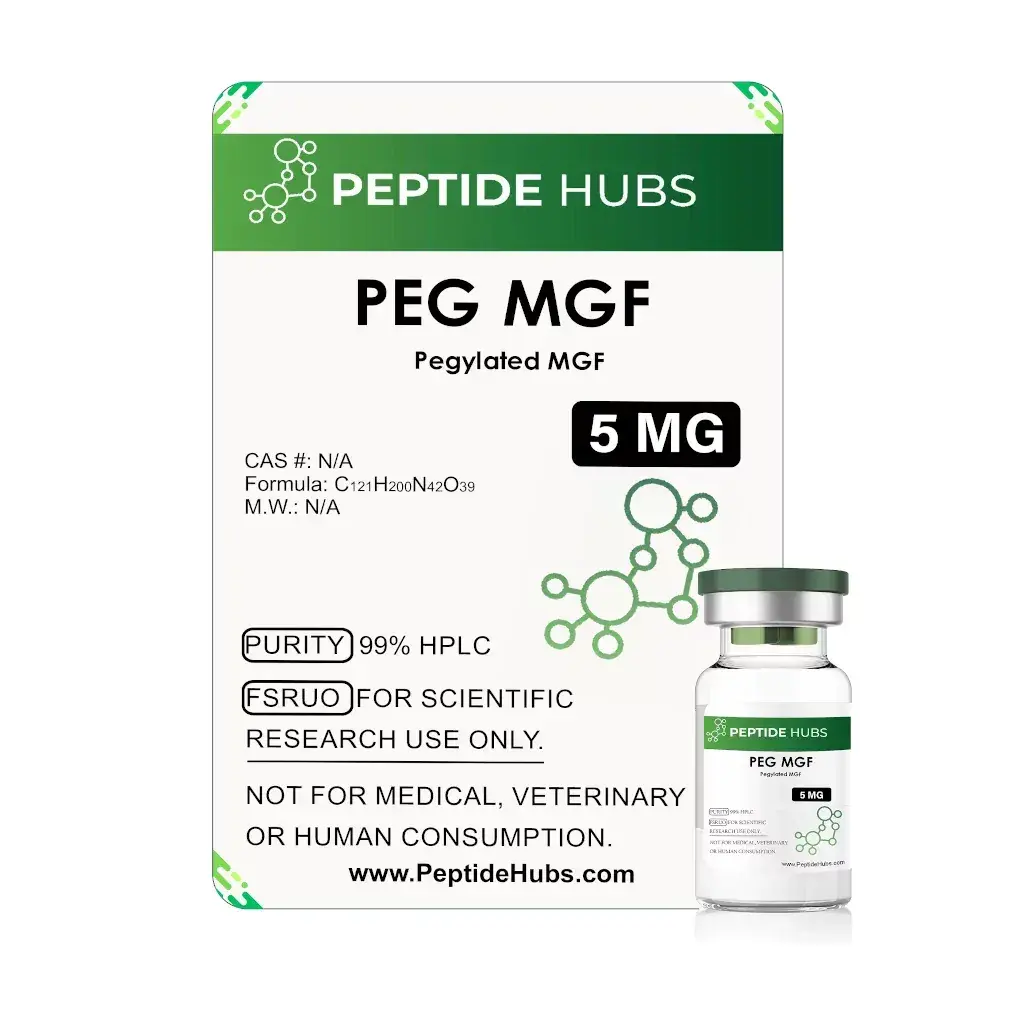
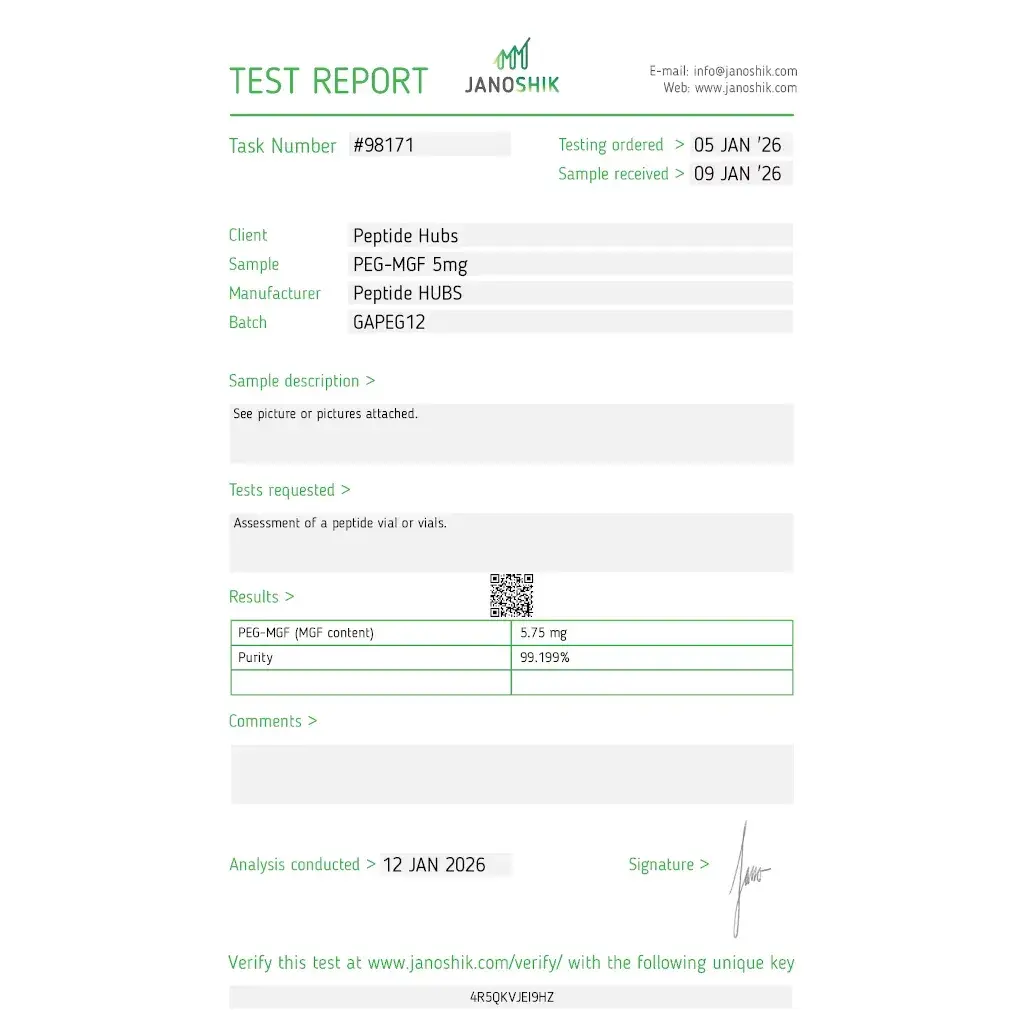
<p>Every batch of Peptide Hubs PEG MGF 5 mg is synthesized in a state-of-the-art, USA-based facility adhering to strict quality control protocols. The final lyophilized product undergoes rigorous analytical testing, including High-Performance Liquid Chromatography (HPLC) to verify purity (>99%), Mass Spectrometry (MS) for sequence and mass confirmation, and endotoxin testing. This commitment to quality ensures researchers receive a precisely dosed, contaminant-free compound, allowing for reproducible and valid experimental outcomes. We stand behind the integrity of our products to support the advancement of legitimate scientific inquiry.</p>
</section>
</div>
Technical Details
Peptide Type
PEGylated Synthetic Peptide
MGF Core Sequence
YQPPSTNKNTKSQRRKGSTFEERK
Peptide Core Length
24 Amino-Acid Residues
Structural Origin
IGF-1Ec C-Terminal E-Domain
Modification
Polyethylene Glycol (PEG) Conjugation
PEG Specification
Not Specified for This Product
Research Status
Experimental / Preclinical